Views: 6
Discover what psychology and research reveal about healthy father-son relationships, plus expert-backed, actionable steps to build, strengthen, or repair that bond at any age.
Key Takeaways
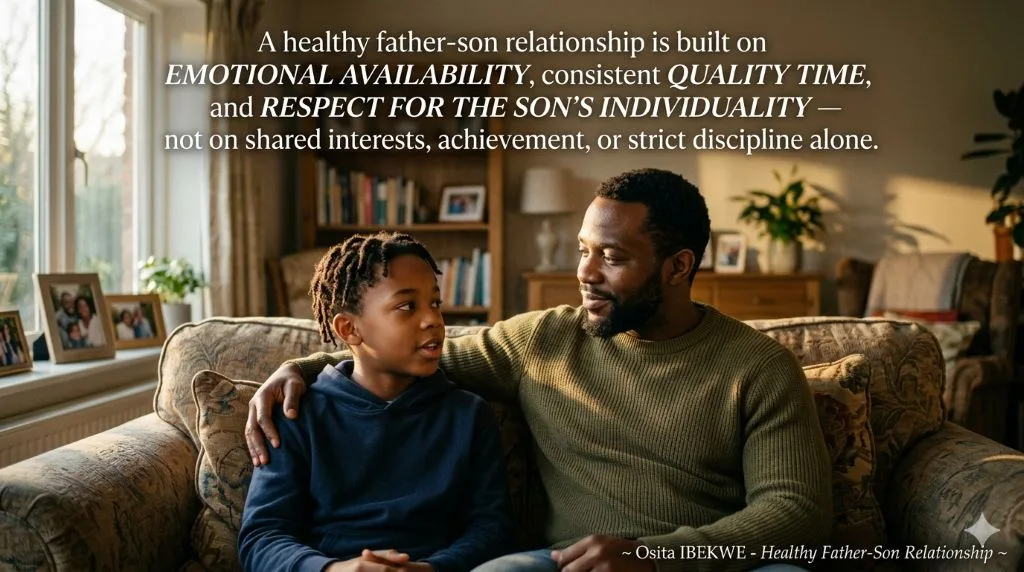
– A healthy father-son relationship is built on emotional availability, consistent quality time, and respect for the son’s individuality — not on shared interests, achievement, or strict discipline alone.
– Decades of psychological and developmental research link strong father-son bonds to better emotional regulation, academic performance, mental health, and lower rates of risky behavior in sons.
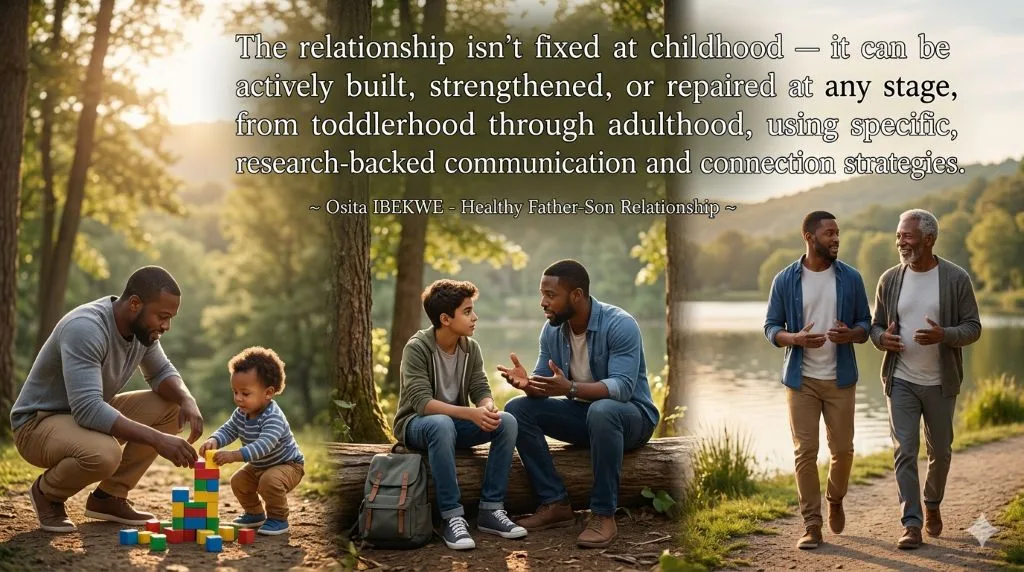
– The relationship isn’t fixed at childhood — it can be actively built, strengthened, or repaired at any stage, from toddlerhood through adulthood, using specific, research-backed communication and connection strategies.
READ ALSO: Healthy Father Daughter Relationship Signs: 8 Key Indicators of Strong Bonds
Table of Contents
- Healthy Father-Son Relationship: Building Bonds That Last
- What Does a Healthy Father-Son Relationship Look Like?
- Why the Father-Son Bond Matters: What the Research Shows
- What Are the Signs of a Toxic or Strained Father-Son Relationship?
- How Can Fathers Build a Stronger Bond With Their Sons?
- Nurturing the Bond Across Life Stages: From Childhood to Adulthood
- How Do You Fix a Broken Father-Son Relationship?
- Father-Son Bonding Activities That Build Lasting Memories
- How Can Fathers Raise Emotionally Intelligent Sons?
- FAQs: Father-Son Relationship
- References and Sources
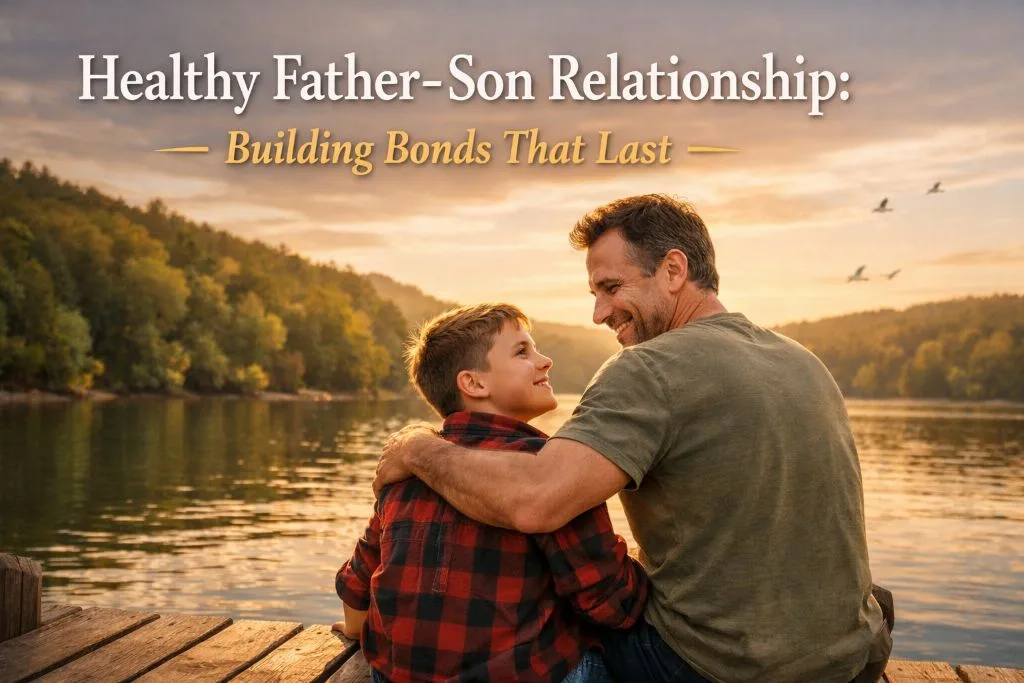
Healthy Father-Son Relationship: Building Bonds That Last
A father and his son can share a house for eighteen years and still feel like strangers across the dinner table. Or they can live three time zones apart and talk every Sunday like best friends. What separates the two isn’t luck — it’s a handful of deliberate habits, repeated over time. This guide draws on developmental psychology, attachment research, and the insights of family therapists and parenting experts to explain what a healthy father-son relationship actually looks like, why it matters so much, and exactly how to build, strengthen, or repair one — whether your son is five, fifteen, or fifty.
What Does a Healthy Father-Son Relationship Look Like?
A healthy father-son relationship is one where both people feel safe being honest, where affection isn’t conditional on performance, and where conflict gets resolved instead of buried. It’s marked by consistent presence, active listening, and a father’s willingness to let his son become his own person rather than a copy of himself.
Researchers and clinicians who study these dynamics point to a few consistent markers of a strong bond:
– Emotional availability — the father notices and responds to his son’s feelings rather than dismissing or minimizing them.
– Mutual respect — disagreements are handled through dialogue, not control or humiliation.
– Unconditional regard — love and approval aren’t tied solely to grades, athletic performance, or career choices.
– Reliable presence — the son can count on his father showing up, even in small, ordinary ways.
– Room for individuality — the father supports the son’s own interests and identity, even when they differ from his own.
This doesn’t mean a healthy relationship is conflict-free. Family therapists who specialize in father-son dynamics note that disagreement is normal in any close relationship; what matters is whether both people feel heard afterward, not whether they agree.
Why the Father-Son Bond Matters: What the Research Shows
The quality of a father-son relationship has measurable effects on a son’s emotional, social, and even physical development — effects that researchers have tracked from early childhood into late adulthood.
A study highlighted by the American Psychological Association found that the rough-and-tumble physical play common between fathers and sons does more than burn energy; it appears to stimulate problem-solving skills, and early parent-child relationship quality has been linked to physical health outcomes that persist later in life. Psychologists studying the same data noted that the parent-child bond isn’t one-directional — adult children’s wellbeing and their parents’ wellbeing tend to move together over time.
This influence doesn’t stop when sons grow up. A University of California, Berkeley study using national social-network data found that adult men who described their fathers as emotionally close tended to have broader and stronger social networks of their own, suggesting that fathers help shape how their sons relate to other people well into adulthood. Separate cross-generational research has found that fathers today report feeling closer to their own sons, and expressing more affection toward them, than they recall receiving from their own fathers — a sign that the father-son bond is actively evolving for the better across generations.
On the developmental and academic side, fatherhood researchers have compiled findings showing that children with consistently involved fathers tend to perform better in school, show greater self-control, and are less likely to act out or engage in risky behavior during adolescence. The research consistently emphasizes one nuance that matters for any father reading this: the quality of the relationship predicts outcomes far more reliably than the sheer number of hours spent together.
The flip side carries weight too. A large UK birth-cohort study tracking thousands of children found that the absence of a biological father was associated with elevated depressive symptoms from adolescence into young adulthood, with the effect varying by the child’s sex and how early in life the absence occurred. U.S. government and family-research data are frequently cited to show that fatherless households are disproportionately represented among indicators like juvenile delinquency and youth mental health crises — figures that, while drawn from correlational data and not a single definitive study, are echoed across multiple independent sources and underline why father involvement is treated as a public-health-relevant variable, not just a private family matter.
YOU MAY LIKE: Healthy Father-Daughter Relationship Psychology
What Are the Signs of a Toxic or Strained Father-Son Relationship?
A strained father-son relationship usually shows up as a pattern, not a single bad day. Family therapists who work with fathers and sons point to several recurring red flags:
– Chronic criticism that targets the person rather than the behavior (“you’re lazy” instead of “I’m worried about your grades”).
– Emotional unavailability, where the father is physically present but rarely engaged — conversations stay limited to logistics or surface-level topics like sports and weather.
– Conditional approval, where love and praise seem to depend on achievement, obedience, or living up to the father’s own unmet ambitions.
– Avoidance of vulnerability on either side, often rooted in cultural messaging that equates masculinity with emotional stoicism.
– Parentification, where the son is pushed into a caretaking or peacekeeping role that isn’t appropriate for his age.
– Unresolved old wounds that resurface in new arguments because they were never actually discussed.
None of these signs alone means a relationship is broken beyond repair. They’re signals — the same way a fever signals infection rather than diagnosing the disease itself. Recognizing the pattern is the first step toward changing it.

How Can Fathers Build a Stronger Bond With Their Sons?
Strengthening a father-son relationship comes down to a small set of repeatable behaviors rather than one big gesture. Below are the strategies most consistently recommended by family psychologists and parenting researchers, with practical ways to apply each one.
- Protect real one-on-one time — and make it predictable.
One frequently cited finding from parenting researcher David Walsh suggests the average school-age boy spends as little as 30 minutes a week in one-on-one conversation with his father, even when that father lives in the home. Counteracting this doesn’t require a vacation; it requires a standing appointment. A weekly walk, a Saturday morning errand together, or ten minutes of uninterrupted conversation before bed, done consistently, builds more trust than an occasional big outing.
- Practice “emotion coaching” instead of emotion-shutting-down.
Psychologist John Gottman’s widely cited emotion-coaching framework outlines a five-step approach fathers can use in the moment: notice the emotion before it escalates, treat the moment as a chance for connection rather than an interruption, listen without immediately problem-solving, help your son put a word to what he’s feeling, and only then work together on next steps or boundaries. The order matters — naming the feeling before fixing the problem makes sons more likely to come back next time something is wrong.
- Make affection routine, not occasional.
Communication researcher Kory Floyd’s Affection Exchange Theory holds that the frequency of affectionate communication — verbal and physical — directly predicts relationship closeness. A hug, a “proud of you,” or a hand on the shoulder costs nothing and compounds over years.
- Model the respect you want him to show others.
How a father treats his son’s mother, siblings, and other people becomes the son’s working definition of respect, long before any lecture does. Sons consistently report that watching a father treat others with patience and dignity — rather than hearing about it — is what actually shapes their own behavior in relationships later in life.
- Validate before you advise.
Fathers are often wired to solve problems immediately. Therapists working with father-son pairs recommend reflecting back what a son says first (“That sounds frustrating”) before offering a fix or an opinion — it signals that the son’s experience matters on its own, not just as a problem to be managed.
- Find shared ground, even in small doses.
Shared activities — a hobby, a sport, a show you both watch — aren’t just entertainment. They create low-pressure space where deeper conversation can happen naturally, without either person feeling put on the spot.
CHECK THIS OUT: Healthy Father-Daughter Relationship: Build Strong Bonds & Boost Confidence (2025 Guide)
Nurturing the Bond Across Life Stages: From Childhood to Adulthood
A father-son relationship doesn’t stay static, and the strategies that work at one age can fall flat at another.
Early childhood (0–6 years): This is the foundation stage for attachment. Physical play, responsiveness to a toddler’s distress, and simple daily routines (bath time, bedtime stories) build the secure base that later stages depend on.
Middle childhood (6–14 years): Psychologist Steve Biddulph, author of the bestselling parenting guide Raising Boys, describes this window as the “father stage,” when a boy increasingly looks to his father — or a father figure — as his primary model for what it means to be a man. Hands-on teaching, shared projects, and consistent rules (paired with warmth, not just discipline) matter most here.
Adolescence (13–19 years): Sons typically pull toward independence while fathers often struggle to loosen control — a normal but friction-prone mismatch. The fix isn’t forcing closeness; it’s staying available, dialing back criticism, and choosing low-pressure shared activities over confrontational “deep talks” that teenagers tend to resist.
Adulthood: The relationship becomes a choice both people actively renew rather than one shaped by daily proximity. Family counselors note that the healthiest adult father-son relationships shift from a hierarchy (parent instructing child) to something closer to mutual friendship — built on shared respect, regular contact, and a willingness from the father to ask his grown son about his life rather than only offering advice about it.
How Do You Fix a Broken Father-Son Relationship?
Repairing a strained or distant father-son relationship rarely happens through one dramatic conversation. Therapists who specialize in family repair point to a more gradual process:
– Acknowledge the past directly. A simple, specific admission — “I know I was hard on you growing up” — does more than a vague apology, because it shows the father actually remembers and takes ownership of specific moments.
– Start with low-pressure shared activities, not forced vulnerability. Watching a game together, running an errand, or working on a small project side by side often opens the door to conversation more effectively than sitting down and demanding to “talk about feelings.”
– Use “I” language instead of accusations. “I felt unheard when…” lands very differently than “You never listened.”
– Be patient with inconsistency. Trust rebuilds through repeated, reliable small actions — not promises — and setbacks along the way don’t erase the progress already made.
– Bring in a neutral third party when needed. Family therapy gives both people a structured, less emotionally charged space to address long-standing resentment, particularly when conversations tend to escalate quickly on their own.
For adult sons specifically, relationship-repair specialists suggest starting smaller than expected: asking a father genuine, low-stakes questions about his own life and history. Many fathers find it easier to open up about the past than about present-day feelings, and that historical conversation often becomes a bridge to a more honest relationship.
Father-Son Bonding Activities That Build Lasting Memories
The best bonding activities aren’t necessarily expensive or elaborate — they’re chosen based on what genuinely interests the son, not just what the father enjoys or remembers from his own childhood. Some consistently recommended options include:
– Shared physical activity — hiking, shooting hoops, biking, or simply walking the dog together, which combines movement with low-pressure conversation.
– A long-term project — building or fixing something together, from a birdhouse to a car, gives both people a shared goal and a natural reason to problem-solve as a team.
– Cooking a meal together, which doubles as a life-skills lesson and a built-in opportunity to talk while working with your hands.
– Reading the same book or watching the same series, which gives both people something concrete to discuss without it feeling like an interrogation.
– Service or volunteer work, which research on family bonding suggests strengthens relationships by turning attention outward — toward a shared purpose — rather than inward toward potential points of friction.
– A recurring ritual, such as a standing Sunday breakfast or annual trip, that doesn’t depend on a special occasion to happen.
How Can Fathers Raise Emotionally Intelligent Sons?
Raising an emotionally healthy son starts with how a father handles his own emotions, not just his son’s. Boys absorb far more from watching a father navigate frustration, disappointment, or sadness than from being told to “be tough.”
Parenting researchers studying boyhood and masculinity describe a pattern: from infancy, boys are often spoken to less about feelings than girls are, and are more frequently encouraged to suppress emotional displays in the name of toughness. Psychologist Michael Reichert, who has spent decades researching boys’ emotional development, has noted that this conditioning leaves many boys disconnected from everything except anger, since that’s often the only emotion masculine norms still permit.
Fathers can counter this pattern with a few concrete habits:
– Name emotions out loud, both your son’s and your own (“I’m feeling pretty stressed about work today”).
– Let your son see you express sadness or worry occasionally, rather than only anger or frustration — it signals that the full emotional range is allowed.
– Treat tears or anxiety as information, not weakness — something to understand, not shut down.
– Separate masculinity from stoicism. Strength is increasingly understood by family psychologists not as suppressing feeling, but as being able to hold and express it without it controlling your behavior or hurting others.
This shift matters beyond the household. Researchers tracking what’s been described as a loneliness epidemic among young men point to early emotional suppression as a contributing factor — boys who never learn to name and share their feelings often struggle to build close adult friendships later, making this one of the highest-leverage things a father can teach.
FAQs: Father-Son Relationship
Why is the father-son relationship important?
A father’s involvement shapes a son’s emotional regulation, self-esteem, academic outcomes, and even his future relationship patterns. Research consistently links a strong, positive father-son bond to lower rates of anxiety, depression, and risky behavior in sons, both during childhood and well into adulthood.
What are the signs of a healthy father-son relationship?
Open communication, consistent emotional availability, mutual respect during disagreements, affection that isn’t tied to performance, and room for the son to develop his own identity are the clearest signs of a healthy bond.
Can a father-son relationship improve after years of distance?
Yes. Family therapists consistently report that father-son relationships can be rebuilt at any age, though the process is usually gradual — built through small, low-pressure shared activities and honest acknowledgment of the past rather than a single resolving conversation.
How does father absence affect a son’s mental health?
Longitudinal research, including a large UK birth-cohort study, has linked biological father absence to higher rates of depressive symptoms from adolescence into adulthood, with the impact varying based on the child’s sex and the age at which the absence occurred.
How much one-on-one time does a father need to spend with his son?
There’s no fixed number, and research suggests quality of interaction matters more than quantity. Consistent, predictable one-on-one time — even just 20 to 30 minutes several times a week — tends to build more trust than infrequent, longer outings.
What should a father avoid doing to protect the relationship?
Chronic criticism, conditional approval based on achievement, dismissing his son’s emotions, and comparing him unfavorably to siblings or peers are among the most commonly cited relationship-damaging patterns identified by family counselors.
Does the father-son relationship change once the son becomes an adult?
Yes — the dynamic typically shifts from a parent-child hierarchy toward something closer to a peer relationship, built on mutual respect, regular contact initiated by both sides, and a father’s willingness to ask about his adult son’s life rather than only advising him on it.
Building a Bond That Lasts a Lifetime
A healthy father-son relationship isn’t the product of one perfect conversation or one unforgettable trip — it’s built in ordinary, repeated moments: a question asked and actually listened to, an apology offered without excuses, a Saturday morning kept free week after week. The research is consistent on one point above all others: presence, practiced consistently and paired with emotional honesty, does more for a son’s wellbeing than any single grand gesture ever could. Whether the relationship needs to be built from scratch, deepened, or repaired after years of distance, the path forward is the same — small, deliberate steps, taken again and again.
References and Sources
- American Psychological Association. The Power of Dad. Monitor on Psychology, 2010.
- National Institutes of Health / PMC. Connecting Fathers: Fathers’ Impact on Adult Children’s Social Networks.
- National Institutes of Health / PMC. The Causal Effects of Father Absence.
- National Institutes of Health / PMC. Father Absence and Trajectories of Offspring Mental Health Across Adolescence and Young Adulthood: Findings From a UK Birth Cohort.
- National Fatherhood Initiative. Father Absence Statistics.
- Children’s Bureau. A Father’s Impact on Child Development.
- Dynamics of Father-Son Attachment: Exploring Communication Patterns and Influencing Factors. International Journal of Indian Psychology / Psychopedia Journals, 2025.
- Wellnest. What Are the Signs of a “Bad” Father-Son Relationship?
- Sagebrush Counseling. 10 Signs of a Bad Father-Son Relationship.
- Dr. Rachel Glik. It’s Never Too Late to Build a Stronger Bond With Your Father: Tips for Adult Children.
- Mother.ly. It’s Science: Affection Is the Key to Building a Strong Father + Son Bond.
- WebMD. How to Be a Better Father to Your Son(featuring psychologist Michael J. Diamond, PhD).
- Today’s Parent. How to Raise Boys Who Are Emotionally Intelligent.
- Dr. Sarah Bren Podcast. Raising Emotionally Intelligent Sons: Parenting Boys to Combat “Toxic Masculinity” with Ruth Whippman.
- Generation Mindful. Raising Emotionally Healthy Boys.
- Manhood Journey. 10 Father and Son Activities That Build Forever Bonds.
- Project Bold Life. Build Up the Bond: Strengthening Father and Son Relationships.