Views: 3
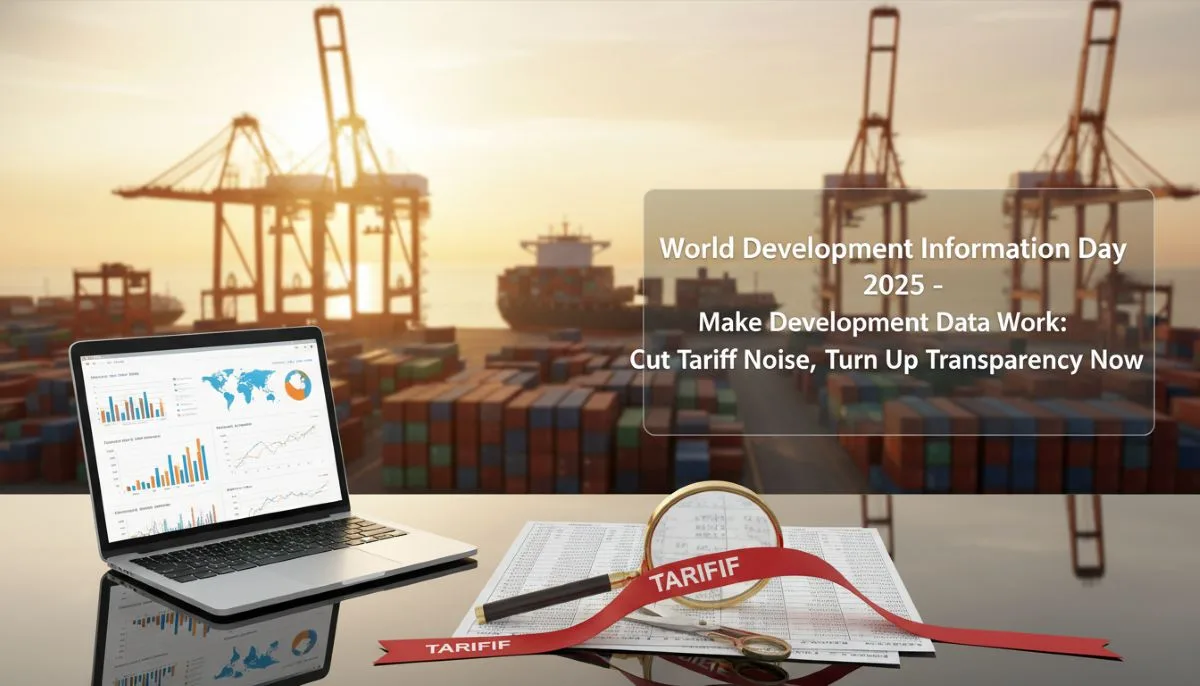
World Development Information Day 2025 arrives amid a familiar fight: rising tariffs, fracturing supply chains, and contested claims about who wins and who pays. Over the past year, the United States extended or tightened trade measures on strategic goods, while several governments responded with export controls and subsidy probes. Consumers heard blame traded as freely as accusations. What was scarcer was trustworthy, comparable development data on costs, jobs, and climate risk. That gap is no longer a nuisance—it is a policy failure.
This editorial takes a clear position: in a fragmented trading system, development advances only if information is credible, open, and used. Policymakers should pair any new trade restrictions with mandatory, timely disclosure of economic and social effects—and invest in statistical systems that shield facts from political pressure. Without this, democracies falter, inequities widen, and climate and health goals drift. With it, lawmakers and the public can weigh trade‑offs, target relief, and keep the rule of law intact.
We recognize that some argue speed beats transparency in strategic sectors. But even expedited actions can include time‑bound reporting and sunset reviews. Security and openness are not mutually exclusive; secrecy just hides who pays. On World Development Information Day 2025, the imperative is to elevate development data transparency and make it actionable.
Why this matters now
In the last 12 months, Washington has kept or expanded tariffs on semiconductors, electric vehicles, and select clean‑tech inputs, framing them as industrial and security tools. Partners launched mirror investigations and controls. According to the World Trade Organization’s recent statistical updates, global merchandise trade has been flat to slightly negative, with volatility rising even as services trade grew. The International Monetary Fund notes ongoing inflation spillovers from supply chain fragmentation, which hit low‑income households hardest—a reminder that trade tariffs and inflation are linked in ways that demand clearer measurement.
Developing countries—especially lower‑income, commodity‑reliant exporters—have thin fiscal buffers after pandemic shocks. Price spikes in fertilizers, clean‑energy components, and essential medical supplies strain food security, health systems, and climate adaptation budgets. At the same time, governments have promised more open data, yet reporting remains uneven, delayed, and opaque at subnational levels. Civil society and small businesses lack the timely, comparable information needed to plan and hold policymakers accountable. Open data for development and better supply chain resilience metrics are not luxuries; they are necessities.
Background: what the data shows
-
According to the World Bank’s Global Economic Prospects, trade growth has slowed as policy uncertainty rises and investment hesitates—underscoring why World Development Information Day should catalyze reforms that improve the quality and timeliness of public data.
-
The U.S. International Trade Commission’s analyses of Section 301 and 232 measures suggest tariff pass‑through to consumer prices varies by sector but can be significant for everyday goods, especially where the U.S. trade war impact on the Global South compounds local vulnerabilities.
-
The International Energy Agency reports that clean‑tech deployment continues globally, but installations slow when costs rise and policy supports are unclear—another case for transparent, comparable indicators.
-
OECD Trade in Value Added data shows continued concentration in critical inputs, exposing economies to disruption and highlighting the need for digital public infrastructure that can surface risk without exposing firm secrets.
None of these sources tell a single story of winners and losers; instead, they reinforce a need for consistent, timely, and accessible reporting so voters and legislators can see who benefits and who pays.
Who benefits, who pays
-
National security and resilience: Proponents argue tariffs and screening protect critical supply chains. Concentrated risk in advanced chips is real. Yet without granular, time‑series disclosure on capacity, prices, and substitution paths, proportionality is hard to judge. Policy by assertion breeds overreach.
-
Inflation and inequity: Independent trackers over the past year indicate tariff‑linked price pass‑through in select categories. Low‑income households, whose budgets tilt toward essentials, bear more of the burden. Small importers—without hedging tools—face tighter margins than multinationals.
-
Rule of law and predictability: Frequent, ad hoc measures announced by press release rather than process raise uncertainty. According to watchdogs, when agencies skip transparent cost‑benefit analyses or delay publishing methodology, litigation rises and compliance costs escalate.
-
Climate and public health: Trade measures can support clean industry. But if they raise the cost of solar modules, heat pumps, generic medicines, or diagnostic equipment without offsetting policies, emissions and health outcomes suffer. Evidence is mixed: where governments paired tariffs with targeted rebates and clear reporting, deployments persisted; where they did not, installations slowed.
Policy options and trade‑offs
-
Stay the course with broad tariffs and minimal reporting. This is administratively easy but worsens opacity and inequity, fuels price pressures, and delays investment.
-
Shift to narrow, risk‑based controls with mandatory disclosure. This demands more capacity but improves accountability and aligns with rule‑of‑law norms.
-
Prioritize subsidy‑first industrial policy, limited tariffs, and open procurement data. Politically harder upfront, but it reduces consumer price impacts and invites allied co‑investment.
What’s new—and why feasibility is improving—is the tooling. Digital public infrastructure, invoice‑level customs data, and privacy‑preserving analytics let agencies publish timely, aggregated indicators without exposing firm secrets. In short, the technology now exists to deliver supply chain resilience metrics that inform better policy.
Recommendations: specific, time‑bound actions
-
Pair every new tariff or export restriction with a 90‑day Impact Dossier
-
-
Responsible: Commerce and trade ministries; national statistics offices.
-
Deliverables: Plain‑language brief with methods; estimated consumer price impacts by income quintile; sectoral jobs; climate implications. Update quarterly for one year.
-
Rationale: Allows oversight, supports targeted relief, and deters overbroad measures.
-
Likely obstacles: Confidentiality claims. Mitigation: Aggregate results and use differential privacy.
-
-
Fund a Development Data Stabilization Grant for low‑ and middle‑income partners (12 months)
-
-
Responsible: Finance ministries; development banks; donor agencies.
-
Deliverables: Grants to modernize trade, price, and household‑survey pipelines; condition on open, machine‑readable releases within 60 days.
-
Rationale: Better partner data reduces miscalibrated sanctions, quotas, and rules of origin; supports equity and open data for development.
-
Obstacles: Fiscal constraints, capacity. Mitigation: Modest donor funds yield large spillovers; pair with technical assistance.
-
-
Launch an Open‑Standard Supply Chain Risk Dashboard (within six months)
-
-
Responsible: Industry ministries; competition authorities; standards bodies.
-
Deliverables: Public indicators of concentration, lead times, and substitution at HS‑6 level for critical inputs (medicines, fertilizers, clean‑tech components); include methodology and revision logs.
-
Rationale: Markets adjust faster with transparent risk; reduces panic buying and stockouts; provides actionable supply chain resilience metrics.
-
Obstacles: Data fragmentation. Mitigation: Require contributions from major buyers via procurement conditions.
-
-
Protect statistical independence (next legislative session)
-
-
Responsible: Legislatures; executive oversight bodies.
-
Deliverables: Statutes that guard against political interference; codified release calendars; peer review of major impact assessments.
-
Rationale: Credible development data transparency undergirds democracy and investor confidence.
-
Obstacles: Short‑term political incentives. Mitigation: Bipartisan sponsorship; public commitments from industry.
-
-
Targeted relief and inclusion guardrails (immediate)
-
-
Responsible: Treasuries; social‑protection agencies; small business authorities.
-
Deliverables: Time‑limited rebates or vouchers if tariffs raise essentials; accessible complaint channels for small importers/exporters; civil‑liberties safeguards for any new data collection.
-
Rationale: Blunts regressive effects; protects rights as data flows increase, especially in communities most affected by the U.S. trade war impact on the Global South.
-
Obstacles: Administrative burden. Mitigation: Use existing benefits rails and community partners.
-

What readers should know now
-
Tariffs and controls can protect, but without disclosure they often shift costs to consumers.
-
Small firms and low‑income households are most exposed to price swings.
-
Clean‑tech and health‑care supply chains are sensitive to trade friction.
-
Transparent supply chain resilience metrics help target relief and investment.
-
Lawmakers can require impact reports before tariffs bite.
-
World Development Information Day is a reminder: open data for development is how democracies stay accountable.
Call to action: steps for this week
-
Contact your representative to support statutory 90‑day Impact Dossiers for any new tariff or export curb—core to development data transparency.
-
Ask city or state officials to publish procurement data for medicines and clean‑tech, including delivery delays and price changes, as open data for development.
-
If you run a small business, share non‑proprietary supply‑delay data with your chamber of commerce to improve local supply chain resilience metrics.
-
Participate in household price surveys if invited; accurate baskets protect consumers from trade tariffs and inflation.
-
Encourage local schools and universities to teach data literacy tied to real trade and price indicators, aligned with World Development Information Day 2025.
Conclusion: the principle at stake
Facts are a public good. On World Development Information Day 2025, the test is whether we will fund, protect, and use them in the heat of a trade war—not only in calmer times. Transparent, timely, and independent data will not dissolve geopolitical rivalry. It will do something more practical: illuminate trade‑offs, uphold the rule of law, and keep development anchored to people, not slogans. The path forward is not to mute debate, but to measure it—through open data for development, credible supply chain resilience metrics, and accountable policies that soften trade tariffs and inflation where they hit hardest.
Sources
-
World Bank, Global Economic Prospects (June 2025). Trends and risks in trade and investment. World Bank — Global Economic Prospects
-
World Trade Organization, World Trade Outlook and Statistics (2024–2025 updates). Merchandise and services trade trends. WTO — Statistics and Outlook
-
U.S. International Trade Commission, Economic impact analyses of Section 301/232 tariffs (recent dockets and reports, 2024–2025). Pass‑through and sectoral effects. USITC — Research and Publications
-
International Monetary Fund, World Economic Outlook (April 2025). Inflation spillovers and fragmentation. IMF — World Economic Outlook
-
International Energy Agency, Renewable Energy Market Update (2025). Clean‑tech deployment under trade frictions. IEA — Renewable Energy Market Update
-
United Nations Statistics Division, Fundamental Principles of Official Statistics; SDG Global Database (accessed 2025). Standards and release practices. UNSD — Statistics
-
OECD, Trade in Value Added (2025). Concentration and exposure in supply chains. OECD — TiVA
Note: This editorial offers policy recommendations and general information. It is not legal or medical advice. Where evidence is mixed or evolving, we indicate uncertainty and prioritize transparent, repeatable methods.