
Views: 38
Learn how to conduct a family therapy session from intake to closing. This step-by-step guide covers preparation, goal setting, activities, debriefing, progress notes, and ethical practice for therapists and counselors.
Table of Contents
- Introduction on How to Conduct a Family Therapy Session
- What This Guide Covers
- Before the Session: Preparation and Intake
- The First Family Therapy Session: Building the Frame
- How to Structure a Family Therapy Session
- How to Choose and Adapt Family Therapy Activities
- Managing Resistance, Conflict, and Emotional Flooding
- Documentation, Progress Notes, and Follow-Up
- Ethical Considerations and When to Refer Out
- A Personal Reflection
- Downloadable Family Therapy Session Planning Template
- FAQs About How to Conduct a Family Therapy Session
- What should a family therapy session look like?
- How long should a family therapy session last?
- What do you say in the first family therapy session?
- How do you handle a family member who refuses to talk?
- How do you keep family therapy sessions from turning into arguments?
- What is the most important part of a family therapy session?
- How do you take notes during a family therapy session?
- Can you do family therapy with only some family members present?
- How do you know when family therapy is working?
- What should a new family therapist avoid?
- Conclusion on How to Conduct a Family Therapy Session
- References and Sources
Introduction on How to Conduct a Family Therapy Session
A few years ago, I sat in a small room with my wife and one of our children while a family therapist asked us a simple question: “What would be different at home if this conversation went well today?”
That question changed how I think about family therapy. Before that moment, I saw therapy as a place where people talk about problems. After that moment, I saw it as a place where people practice new ways of being together.
If you are a therapist, counselor, social worker, or graduate student learning family systems work, you already know that family therapy is different from individual therapy. You are not treating one person. You are working with a system of relationships, histories, loyalties, and unspoken rules. One comment from a teenager can shift the entire room. One parent’s silence can speak louder than any words.
This guide explains how to conduct a family therapy session from start to finish. It is practical, structured, and grounded in established family systems thinking. Whether you are preparing for your first family session or refining your approach, you will find a clear process you can adapt to your setting.
If you are looking for specific exercises to use inside these sessions, our guide to family therapy activities includes more than 50 evidence-based exercises organized by age and goal. You can also download our free Family Therapy Activities Quick Reference Sheet for a one-page cheat sheet.

What This Guide Covers
- How to prepare before the first session
- How to structure the first family therapy session
- How to set goals with the whole family system
- The standard flow of a family therapy session
- How to choose and adapt activities
- How to manage resistance, conflict, and emotional flooding
- How to document progress and plan follow-up
- Ethical considerations and when to refer out
- A printable family therapy session planning template
- FAQs for new family therapists
Before the Session: Preparation and Intake
Good family therapy begins before anyone enters the room. The intake process helps you understand who is in the family, why they are coming, and what each person hopes will change.
Gather basic information
Collect names, ages, relationships, living arrangements, and contact details. Note who is legally able to consent for minors. If you work in a setting that requires insurance authorization, confirm coverage and session limits early.
Understand the presenting problem from multiple perspectives
Ask each family member, separately if possible, to describe what brings them in. The parents may say the teenager is disrespectful. The teenager may say the parents never listen. A younger child may say everyone yells. These different stories are not contradictions. They are data about how the family system experiences the same problem.
Screen for safety risks
Before bringing the family together, screen for domestic violence, child abuse, substance use, self-harm, suicidal ideation, and untreated severe mental illness. If any of these are active and uncontrolled, a full family session may not be safe. You may need individual sessions, safety planning, or a referral before family work can begin.
Set expectations
Tell the family what family therapy is and is not. Explain that you will not take sides, that everyone will be asked to participate, and that change often feels uncomfortable before it feels better. Clarify fees, cancellation policies, confidentiality limits, and how you handle secrets within the family.
The First Family Therapy Session: Building the Frame
The first session sets the tone for everything that follows. Your job is not to solve the problem in 50 minutes. Your job is to build enough trust and structure that the family wants to come back.
Welcome everyone and observe the system
Greet each person by name. Watch who sits where, who speaks first, who looks at whom, and who seems anxious, angry, or withdrawn. These observations are often more useful than anything the family says directly.
Explain your role
Make it clear that you are a facilitator, not a referee or a judge. Your role is to help the family see patterns and try new interactions. You are not there to decide who is right.
Establish ground rules
Common ground rules include:
- One person speaks at a time.
- No name-calling or insults.
- Everyone participates.
- It is okay to take a break.
- What is shared in session stays in session, with the usual safety exceptions.
Invite the family to add their own rules. When they help create the frame, they are more likely to respect it.
Ask each person what they want
Go around the room and ask each family member: “What would you like to be different as a result of coming here?” Write down their answers. This gives you a working agenda and helps each person feel seen.
End with a clear next step
Close the first session by summarizing what you heard and confirming the next appointment. Do not try to fix everything. Your goal is to leave the family with hope and structure.

How to Structure a Family Therapy Session
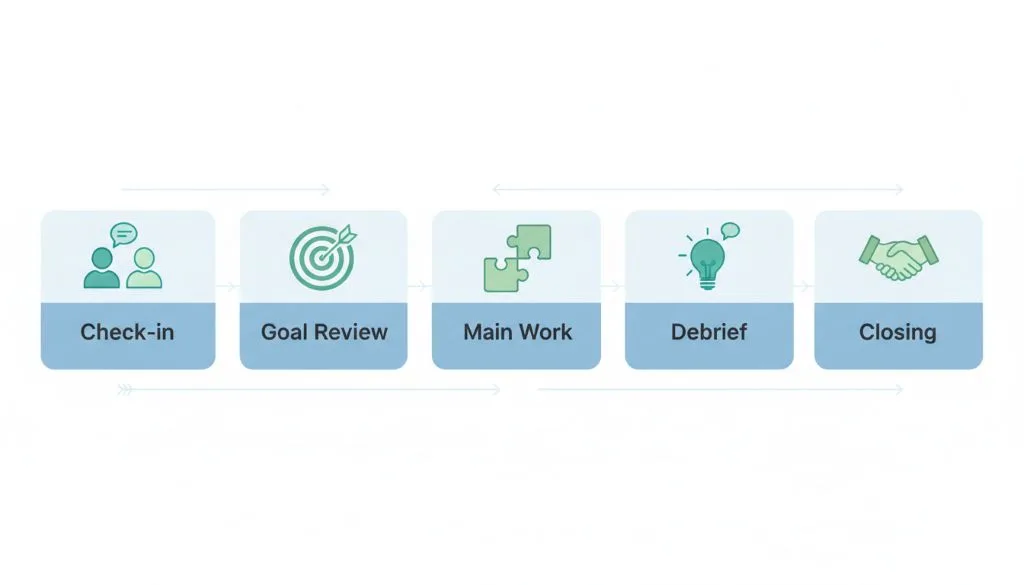
Most family therapy sessions follow a predictable arc. Once the family learns the rhythm, they feel safer and more productive.
1. Check-in (5–10 minutes)
Ask each person to share one word or one sentence about how they are arriving today. This is not the time for problem-solving. It is a transition into the therapeutic space.
2. Review progress and goals (5–10 minutes)
Briefly revisit the goals you set together. Ask what has changed since the last session, even in small ways. This keeps the work focused and reminds the family that change is possible.
3. Main work: activity or conversation (25–35 minutes)
This is the core of the session. You might use a structured activity from our family therapy activities guide, explore a recent conflict, or practice a new communication skill.
Choose the main work based on the family’s readiness. A family in crisis needs stabilization before deep exploration. A family that has built trust can handle more challenging exercises.
4. Debrief (10–15 minutes)
The debrief is where the learning happens. Ask questions like:
- What did you notice during that activity?
- Did anything surprise you?
- What felt hard? What felt easier than expected?
- How is this similar to what happens at home?
- What is one thing you could try differently this week?
Do not skip the debrief. Without it, the activity is just an activity.
5. Closing and homework (5 minutes)
End by summarizing the key insight or action from the session. Assign one small, specific task for the family to practice before the next meeting. Examples include:
- Have a 10-minute family meeting without phones.
- Use the pause button once during a disagreement.
- Each person writes one appreciation for another family member.
Keep homework small. A family that succeeds at a small task builds confidence for bigger work.
How to Choose and Adapt Family Therapy Activities
Not every activity fits every family. The best therapists match the intervention to the system in front of them.
Match the activity to the goal
If the goal is communication, use listening exercises. If the goal is conflict resolution, use problem-solving frameworks. If the goal is trauma recovery, use grounding and safety planning first.
Our family therapy activities guide organizes exercises by goal, age, and therapeutic approach. Use it as a menu, not a script.
Match the activity to the family’s developmental stage
A feelings thermometer works beautifully with a six-year-old but may feel childish to a sixteen-year-old. A digital detox challenge may engage a teenager but bore a younger child. Mixed-age families need activities everyone can participate in at their own level.
Match the activity to the family’s culture
Family structures, communication styles, and values vary widely across cultures. An activity that assumes a two-parent nuclear family may not fit a multigenerational household. An activity that emphasizes direct verbal expression may not fit a family that values indirect communication. Adapt language, examples, and structure as needed.
Always plan the debrief
Before you introduce an activity, know what questions you will ask afterward. The debrief turns experience into insight. Without it, the family may enjoy the activity but leave without understanding why it mattered.

Managing Resistance, Conflict, and Emotional Flooding
Family therapy is emotional work. You will see resistance, arguments, tears, and silence. These moments are not failures. They are part of the process.
How to handle resistance
Resistance usually means someone feels unsafe, unheard, or coerced. Do not push harder. Instead, get curious. Ask:
- “What would need to be different for you to feel okay participating?”
- “Is there something about this activity that does not fit for you?”
- “What are you worried might happen if you join in?”
Sometimes resistance is information. It tells you where the family’s fear or pain is located.
How to handle conflict during a session
Conflict in the room is not always bad. It can show you the family’s real interaction patterns. Your job is to keep it productive and safe.
- Slow the conversation down.
- Ask each person to repeat back what they heard before responding.
- Name the pattern: “I notice that when one of you raises your voice, the other stops talking. Does that happen at home too?”
- Use the pause button if emotions escalate.
How to handle emotional flooding
If someone becomes overwhelmed, stop the activity. Use grounding techniques such as deep breathing, sensory naming, or a short break. Do not force continued exploration. A flooded brain cannot learn. Safety comes first.

Documentation, Progress Notes, and Follow-Up
Good documentation protects you, supports continuity, and helps the family see progress.
What to include in progress notes
- Who attended the session
- The main topics or activities covered
- Key interactions or patterns observed
- The family’s response to the intervention
- Homework or goals for the next session
- Any safety concerns or risk issues
- Your clinical impressions and plan
Use professional, objective language. Avoid labels and judgments. Instead of writing “mother is controlling,” write “mother frequently redirected the conversation toward her concerns.”
How to track progress with the family
Every few sessions, review the goals you set together. Ask the family what is better, what is the same, and what is worse. Use simple rating scales if helpful. For example, ask each person to rate family communication on a scale of 1 to 10 and compare it to the first session.
Plan for termination from the beginning
Talk early about what success would look like and how you will know when therapy is complete. This prevents the family from becoming dependent on sessions and helps them recognize their own growth.

Ethical Considerations and When to Refer Out
Family therapy comes with unique ethical responsibilities. You are working with multiple people who may have conflicting interests.
Informed consent
Make sure every participant understands the purpose of family therapy, the limits of confidentiality, and your policies about secrets. Be clear that you cannot keep secrets that involve safety risks.
Confidentiality within the family
Decide in advance how you will handle information shared in individual conversations. Some therapists do not hold secrets between family members. Others hold limited secrets with clear boundaries. Whatever your policy, explain it clearly and consistently.
When to refer out
Refer to individual therapy or specialized services when you encounter:
- Active domestic violence
- Child abuse or neglect
- Severe untreated mental illness
- Active substance use that makes family sessions unsafe
- A family member who needs trauma processing before family work can be effective
- Situations outside your training or licensure scope
Knowing your limits is a sign of competence, not weakness.
A Personal Reflection
As a father, I have learned that the same principles that guide family therapy also guide family life at home. You cannot force someone to open up. You cannot talk your way out of a pattern that was built over years. But you can create conditions where change becomes possible.
A good family therapy session, like a good family dinner, has structure and warmth. People know they will be heard. They know the conflict will not blow up the room. They know that even when things are hard, they are not alone.
That is what I try to bring into my writing about family therapy. Not just techniques, but the human experience of sitting in a room with people you love and trying to do better.
Downloadable Family Therapy Session Planning Template
To make this guide easier to use, I created a printable session planning template. It includes sections for:
- Pre-session preparation
- Session goals
- Main activity or intervention
- Debrief questions
- Homework assignment
- Progress notes
You can download it here: [Family Therapy Session Planning Template]
FAQs About How to Conduct a Family Therapy Session
What should a family therapy session look like?
A typical family therapy session includes a check-in, a review of goals, a main activity or conversation, a debrief, and a closing with homework. The exact structure depends on the family’s needs and the therapist’s approach.
How long should a family therapy session last?
Most family therapy sessions last 50 to 60 minutes. Some settings use 90-minute sessions for larger families or more complex issues. For young children, shorter sessions of 30 to 45 minutes may work better.
What do you say in the first family therapy session?
In the first session, welcome everyone, explain your role, set ground rules, and ask each person what they hope will change. Do not try to solve the problem immediately. Focus on building trust and understanding the system.
How do you handle a family member who refuses to talk?
Do not force participation. Acknowledge their presence, ask what would make the session feel safer, and give them choices about how to engage. Sometimes silent members begin participating once they see that the session is not a trap.
How do you keep family therapy sessions from turning into arguments?
Slow the conversation down, use structured turn-taking, and name patterns as they happen. Teach skills like active listening and the pause button. Make it clear that the goal is understanding, not winning.
What is the most important part of a family therapy session?
The debrief is often the most important part. It is where the family makes meaning out of what just happened and connects the session to real life. Without reflection, even the best activity loses its impact.
How do you take notes during a family therapy session?
Keep notes brief and write them after the session or during natural pauses. Focus on observable behavior, key themes, and the intervention used. Avoid writing while family members are sharing something emotional, as it can feel cold or distracting.
Can you do family therapy with only some family members present?
Yes. Sometimes one member refuses to attend, or scheduling makes full attendance impossible. You can still do useful systemic work with whoever is present, while acknowledging that the absent person is part of the system.
How do you know when family therapy is working?
Signs of progress include improved communication, fewer escalated conflicts, more flexible roles, and family members reporting that home life feels different. Progress is often uneven, so look for trends over time rather than single sessions.
What should a new family therapist avoid?
New family therapists should avoid taking sides, rushing to solve problems, ignoring power dynamics, skipping the debrief, and working outside their competence. It is also important not to blame one person, usually a child, for the family’s problems.
Conclusion on How to Conduct a Family Therapy Session
Conducting a family therapy session is both a technical skill and a human art. You need structure, preparation, and a clear sense of your role. You also need patience, curiosity, and the ability to sit with discomfort without rushing to fix it.
The best sessions do not end with everything solved. They end with the family seeing something they did not see before and trying something they did not try before. That is where change begins.
If you want a library of activities to use inside these sessions, visit our complete guide to family therapy activities. For a deeper understanding of family systems, read our introduction to Bowenian Family Theory. And if you are working with families affected by unhealthy closeness or enmeshment, our guide to engulfment trauma offers practical insight.
References and Sources
- Minuchin, S., & Fishman, H. C. (2004). Family Therapy Techniques. Harvard University Press.
- Bowen, M. (1978). Family Therapy in Clinical Practice. Jason Aronson.
- Gottman, J. M. (2015). The Seven Principles for Making Marriage Work. Harmony Books.
- Satir, V. (1988). The New Peoplemaking. Science and Behavior Books.
- American Association for Marriage and Family Therapy. (2023). Family Therapy Practice Guidelines. https://www.aamft.org/
- Nichols, M. P., & Davis, S. D. (2020). Family Therapy: Concepts and Methods(12th ed.). Pearson.
- Doherty, W. J., & McDaniel, S. H. (2010). Family Therapy. American Psychological Association.